Sewage Backup Cleanup: What to Do and What Gets Tossed
Of all the ways water gets into a house, this is the one that changes the rules. Clean water from a supply line is a drying problem. Sewage is a contamination problem, and the difference decides what can be saved, who should be in the room, and what your insurance will do about it.
The industry calls it category 3, or black water. It carries bacteria, viruses, and parasites, and it does not need to look dramatic to be dangerous. Two inches of it in a hallway is a biohazard.
The first 30 minutes
In order, and the order matters:
- Get people and pets out of the affected area. Not out of the house necessarily, but out of the wet zone, and keep them out. Children and anyone immune-compromised, pregnant, or elderly should not be in there at all.
- Do not run water. No sinks, no showers, no laundry, no flushing. Every gallon you send down the drain comes back up if the blockage is downstream.
- Kill power to the affected rooms at the breaker if water is anywhere near outlets or cords — but not if you would have to stand in the water to reach the panel.
- Do not run the HVAC. It will move contaminated air through the whole house.
- Photograph it, from the doorway, before anyone touches anything.
- Call. This is not a wait-until-morning loss.
Notice what is not on that list: mopping, shop-vaccing, or spraying bleach. More on why below.
Why sewage is a different job
Clean water damage is a race against time. Sewage is a race against time plus a containment job.
The crew’s problem is not just removing water — it is making sure the contamination does not spread to the rest of the house on foot traffic, air movement, or the equipment itself. That means plastic containment, negative air pressure, protective equipment, and a disposal path for everything that comes out. It is closer to how a mold remediation job is run than how a burst-pipe dry-out is run.
What gets thrown out, and what stays
This is where people are most surprised, and the rule underneath it is simple: porosity. If the material soaked it in and cannot be disinfected all the way through, it goes.
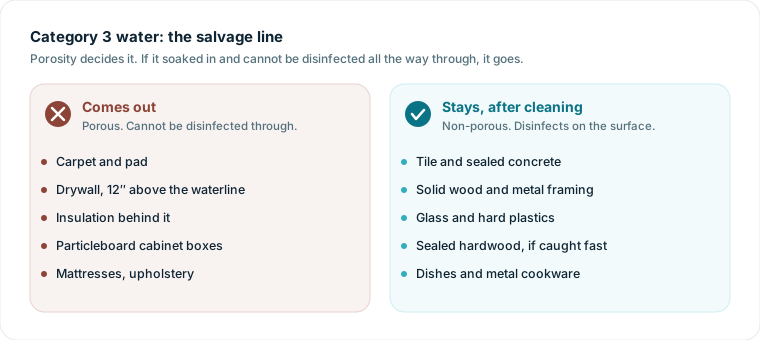
The hardest conversations are usually about carpet and cabinets. Carpet pad is a sponge and is never salvageable in a category 3 loss. Particleboard cabinet boxes wick water up from the toe kick and swell from the inside, so a cabinet that looks fine on day one can be failing by day four.
The drywall cut is typically about 12 inches above the highest waterline, because water wicks upward past where you can see it. That is not the crew being aggressive — it is the line where the material can be verified clean.
Why bleach is not the answer here
Bleach on a porous surface is mostly water. It knocks down the visible staining and wets the substrate underneath, which is the opposite of what you want. It also does not reach into a wall cavity or under a pad, which is exactly where the contamination went.
On hard, non-porous surfaces — tile, sealed concrete, metal, glass — cleaning and disinfecting genuinely works, and that is why those materials stay.
Does insurance cover a sewage backup?
Often, but usually only if you carry the rider. Standard homeowners policies commonly exclude sewer and drain backup, and cover it through a separate water backup endorsement that you have to have added.
That endorsement is typically inexpensive, and in older Valley neighborhoods it is worth having. Root intrusion into clay sewer laterals is routine in the pre-1960s parts of Stockton and Lodi, where mature trees and original laterals have been in the ground a long time. A backup there is not bad luck, it is a maintenance timeline.
Check your declarations page for “water backup” or “sewer backup” before you need it. There is more on how California policies treat water losses in the insurance guide.
Two other things adjusters look for on these claims: whether the backup came from the municipal main or your own lateral, and whether the loss was sudden. Documentation from the first hour is what settles both.
Why this is the wrong DIY
For most water losses, there is a reasonable homeowner version of the first response. This is not one of them.
The exposure is real — pathogens, aerosolized contamination during removal, and the disposal of contaminated material. The equipment matters too: a household wet vac has no containment, no HEPA filtration, and no way to verify the space is clean afterward. And “clean afterward” is not a judgment call. It is verified with moisture readings and, in a category 3 job, documented disinfection of what remained.
There is also a downstream cost. A sewage loss that was surface-cleaned but not properly removed tends to reappear as a mold job in three weeks, and by then you are paying for both.
The short version
Sewage backups are handled fast, contained, and by someone with the equipment to verify the result. Porous material goes; hard surfaces stay. Check for the backup rider on your policy today rather than during a claim.
If it is happening right now, stop using water and call. Sewage and black water cleanup is dispatched 24/7 across San Joaquin and Stanislaus Counties.