Water Stain on Your Ceiling? How to Find the Source
A brown ring on the ceiling is the end of a story that started somewhere else. Four sources account for nearly all of them: a roof leak, a bathroom or laundry directly above, an air conditioning condensate line, or a pipe running through the joist bay. You can usually narrow it to one in an afternoon, without opening anything, by paying attention to when the stain grows.
First, though, one thing to rule out immediately.
If the ceiling is sagging, leave the room
A stain is a clue. A bulge is a warning.
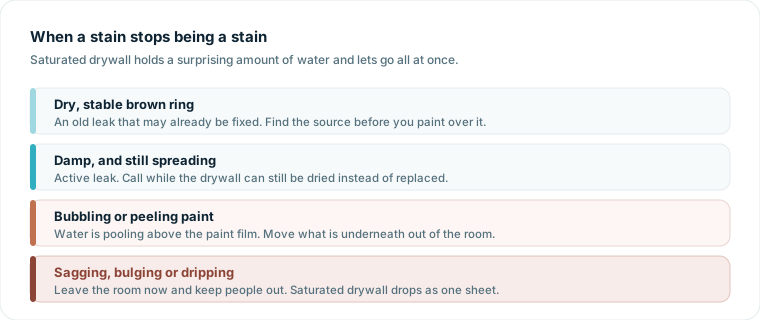
Drywall holds a startling amount of water before it fails, and when it does it comes down as a sheet rather than a trickle. A bulging or sagging ceiling is a load hanging over the room. Get people and pets out, keep them out, and call. Do not stand under it to poke a hole in it, which is advice that circulates widely and puts you directly beneath the thing that is about to fall.
Narrowing it down by timing
The four common sources each have a signature, and the question that separates them is simple: when does the stain get bigger?
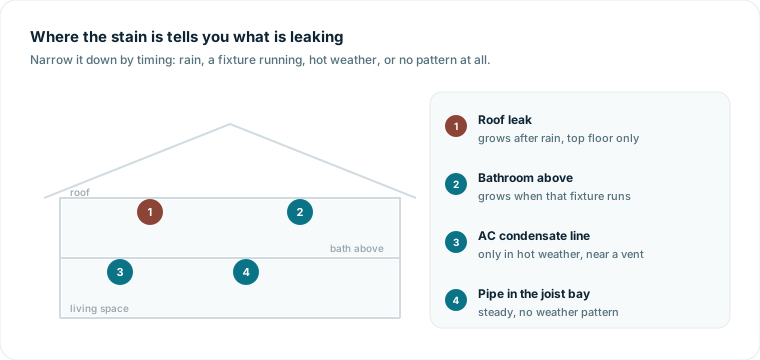
After rain, and only on the top floor. That is a roof leak. Worth knowing: roof leaks rarely show up directly below the hole. Water runs along the top of the ceiling drywall or down a rafter before it finds a low spot, so the stain can be several feet from the actual entry point.
When a specific fixture upstairs runs. A shower, a toilet, a tub, or a washing machine. Run each one for a few minutes with someone watching the stain. A shower that leaks only when someone is actually standing in it usually points to failed grout or a bad shower pan rather than a plumbing fault.
Only in hot weather, near an air vent. That is almost always a clogged air conditioning condensate line. It is among the most common and least expensive items on this list, and it is seasonal, which is the giveaway.
Steadily, with no pattern at all. A supply or drain line in the joist bay. Supply lines drip constantly because they are always pressurized. Drain lines only leak when something upstream is draining, which can look random until you map it.
If nothing above fits, the remaining possibilities are condensation on a duct in an unconditioned attic, or an ice dam equivalent that the Valley does not really get. Condensation is the realistic one here.
What the stain is telling you about age
A dry, stable, yellow brown ring with a crisp edge is usually an old leak that may already have been repaired by a previous owner. A soft edge that is still expanding, or a stain that feels cool and damp to the touch, means water is moving now.
The test most people skip: touch it. Press gently with a fingertip somewhere near the center. Firm and dry means old. Soft, spongy, or cool means active, and the drywall is already compromised.
Why painting over it does not work
Two reasons. The obvious one is that the leak is still there and the stain returns, usually larger.
The less obvious one is that the stain itself bleeds through ordinary paint. The brown is a water soluble tannin lifted out of the drywall paper and the joist above it, and latex paint reactivates it. Even after the leak is genuinely fixed and the area is dry, covering it takes a stain blocking primer, usually shellac or oil based, before the topcoat.
Fixing the paint before fixing the water is the single most common mistake with ceiling stains, and it hides the evidence you would want for an insurance claim.
What the repair actually involves
The ceiling is the easy part. The sequence is:
- Stop the water. A plumber, a roofer, or an HVAC tech depending on which source it turned out to be. Restoration crews do not repair the pipe or the roof, as covered in the plumber versus restoration company breakdown.
- Open the ceiling where it is wet. Insulation above a ceiling leak is almost always saturated, and wet insulation does not dry in place.
- Dry the cavity with air movers and dehumidifiers, verified by meter rather than by eye. Joists and the top side of the drywall are what matters, and both are invisible from the room.
- Replace what came out, then texture, prime with a stain blocker, and paint.
A small, caught-early ceiling leak often means a patch, a few days of drying, and paint. One that ran for months typically means replacing a larger section of drywall and insulation, and sometimes mold remediation if it has been wet long enough. Mold starts on wet material in roughly 48 hours, and a ceiling cavity is dark, still, and insulated, which is close to ideal for it.
Does insurance cover it?
Same test as any water loss: sudden and accidental is usually covered, gradual is usually not.
A supply line that failed and soaked the ceiling overnight is typically a covered claim. A roof that has been leaking slowly for two winters usually reads as deferred maintenance. The repair of the failed component itself, the pipe or the shingles, is generally not covered even when the resulting damage is.
This is another reason not to paint over it. Photograph the stain, date the photos, and keep them. The California insurance guide covers the sudden versus gradual line in more detail.
Quick answers
Is a ceiling water stain dangerous? The stain itself is not. A sagging or bulging ceiling is, and so is water near a light fixture or ceiling fan, which is a shock hazard. Kill the breaker to that circuit.
How much does ceiling water damage repair cost? A small patch with drying and paint is often a few hundred dollars. Larger sections with insulation replacement and mold work run into the thousands. The cost guide has local ranges.
Can I dry it myself with a fan? You can dry the surface. You cannot dry the cavity or the insulation above it, and surface dry with a wet cavity is how mold jobs start.
The stain is dry and has not changed in years. Do I need to do anything? Find out what caused it, confirm the fix, then prime and paint. A stable stain with a known, repaired cause is cosmetic.
If it is still wet
Catching a ceiling leak in the first day is the difference between a paint job and a drywall job. Dispatch answers 24/7 for emergency water removal and drying across Stockton, Modesto, Lodi, Tracy, Manteca, Turlock and the rest of the 209.