Flood Damage Restoration: Why Outside Water Is Different
A burst supply line and a flooded street can put the same two inches of water on the same floor, and produce two completely different jobs. Water from outside is category 3 from the moment it arrives, which means almost nothing porous gets saved, the drywall cut goes higher, and your homeowners policy probably does not cover it.
That last point surprises people every single season, so it is worth understanding before the next storm rather than during it.
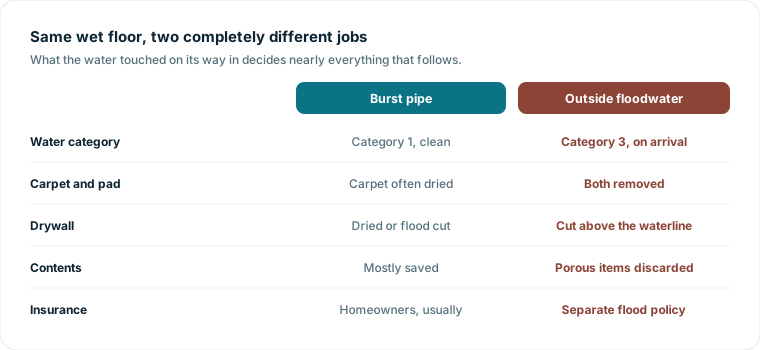
What makes outside water category 3
Water gets classified by what is in it, not by how much of it there is. Clean water from a supply line is category 1. Water from a dishwasher or washing machine is category 2. Category 3 is water carrying contamination that can make people sick, and floodwater qualifies on arrival because of where it has been.
Street flooding picks up whatever is on the ground on its way to your door: fuel and oil runoff, fertilizer and pesticide from yards and fields, animal waste, and in a heavy event, sewage from overwhelmed systems. Agricultural runoff is a genuine local factor in the 209, not a theoretical one.
None of that is visible in the water. It is why crews treat a clear-looking flood the same as an obvious one, and why the sewage cleanup rules largely apply here too.
What gets removed, and why so much
The honest answer is that porous material cannot be verified clean, and category 3 contamination is not something anyone wants to leave behind a wall on a best guess.
So out it goes: carpet and pad together, insulation, particleboard and MDF cabinet boxes, upholstered furniture, mattresses, and drywall up to a line well above the water. Sealed hard surfaces stay: tile, sealed concrete, metal framing, solid wood, glass, and most hard plastics, after cleaning and disinfection.
The drywall cut catches people off guard, because it always sits higher than the water ever reached.
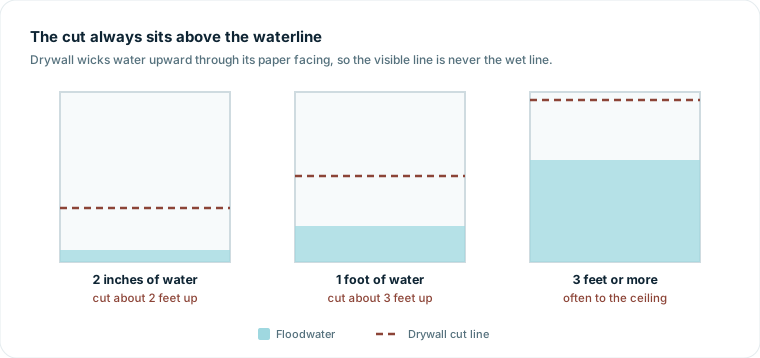
Drywall wicks water upward through its paper facing, so the wet line is always above the visible line. Cutting at the waterline leaves saturated, contaminated material in the wall. The cut height is a judgment call based on meter readings, but the rule of thumb is roughly a foot to two feet above the highest water mark, and a deep flood often means the drywall comes off to the ceiling.
Insurance is the part that catches people
Standard homeowners policies exclude flood. Not limit it. Exclude it. If water entered your home from outside, from a rising creek, an overwhelmed storm drain, a levee failure, or surface runoff, a normal policy does not pay for it.
Flood coverage comes from a separate policy, usually through the National Flood Insurance Program or a private flood insurer. Two details that matter:
- There is typically a 30 day waiting period before a new flood policy takes effect. You cannot buy it when the forecast turns. That is the entire reason to think about this in October rather than February.
- You do not have to be in a mapped high risk zone to buy it, and a significant share of flood claims come from outside those zones. Much of the Valley sits behind levees, which affects the rating but not the physics.
Where it gets genuinely confusing: if a storm blows the roof open and rain comes in from above, that is usually a covered homeowners claim, because the water never touched the ground. Same storm, same house, different coverage entirely, decided by how the water got in. The California insurance guide goes further into this, and claim help is available either way.
How Valley homes actually flood
Not usually a river over its banks. The common local versions are quieter:
- Atmospheric river sequences. Storms arrive back to back, and the second system lands on ground that has not drained. The flood prep guide covers getting ahead of these.
- Overwhelmed storm drains pushing water toward garages and doorways in flat, low lying streets. This is the most common one by a wide margin.
- Saturated ground forcing water into crawl spaces, which is why crawl space water removal is a steady winter call across Stockton, Lodi, and Modesto.
- Irrigation and canal overflow in the agricultural edges around Turlock and Ceres.
What the cleanup involves
The sequence resembles any other water loss, with contamination control layered on top:
- Safety first. Power off to affected areas, and no one walks into standing water near live circuits.
- Extraction of the standing water with truck mounted equipment, the same first step described in the emergency extraction guide.
- Removal and disposal of contaminated porous material, documented and photographed on the way out, because the claim will need that record later.
- Cleaning and disinfection of every hard surface that stayed.
- Structural drying with air movers and dehumidifiers until meter readings hit a documented dry standard.
- Verification, then rebuild.
Expect four to seven days for the mitigation phase on a flood job, longer than a clean water loss because of the extra removal and disinfection. The rebuild follows separately.
What to do while you wait
If water is in the house right now and it came from outside:
- Do not wade through it if you can avoid it, and never near outlets or a panel.
- Do not run a shop vac on it. A household wet vac has no containment and nothing to stop contamination from spreading.
- Photograph everything before anything moves, including a shot that shows the water depth against a wall.
- Pull what you can off the floor if it is safe: documents, electronics, anything with wooden legs.
- Throw out food that contacted floodwater, including sealed containers with screw tops.
Quick answers
Can carpet be saved after a flood? No. Carpet and pad that took in outside water are both removed. The salvage rules by water category cover the full breakdown.
Is flood damage restoration more expensive? Generally yes, because more material comes out and disinfection is added, which also makes the rebuild larger.
Does renters insurance cover flooding? Contents are excluded from flood in a standard renters policy too. Separate flood contents coverage exists.
How long before mold starts? The same roughly 48 hour window applies, and contaminated water does not wait any longer than clean water does.
The short version
Floodwater is dirty on arrival, so the job is a removal job more than a drying job, and your homeowners policy almost certainly excludes it. Check whether you have flood coverage now, while the 30 day waiting period is still just a formality.
If water is already inside, dispatch answers 24/7 for flood damage cleanup across San Joaquin and Stanislaus Counties.